Modular and lightweight backup utility to save, encrypt and verify your personal data.
## Overview
`backup.py` supports two major options: `--backup`, to create a new backup and `--extract`
to extract an existing backup archive.
In order to create a backup file, you first need to create a *"sources file"* to specify
the absolute paths to backup. For instance:
```ini
# directories end with a slash...
photos=/home/marco/Pictures/
documents=/home/marco/Documents/
# while individual files do not
wireguard=/etc/wireguard/wg0.conf
```
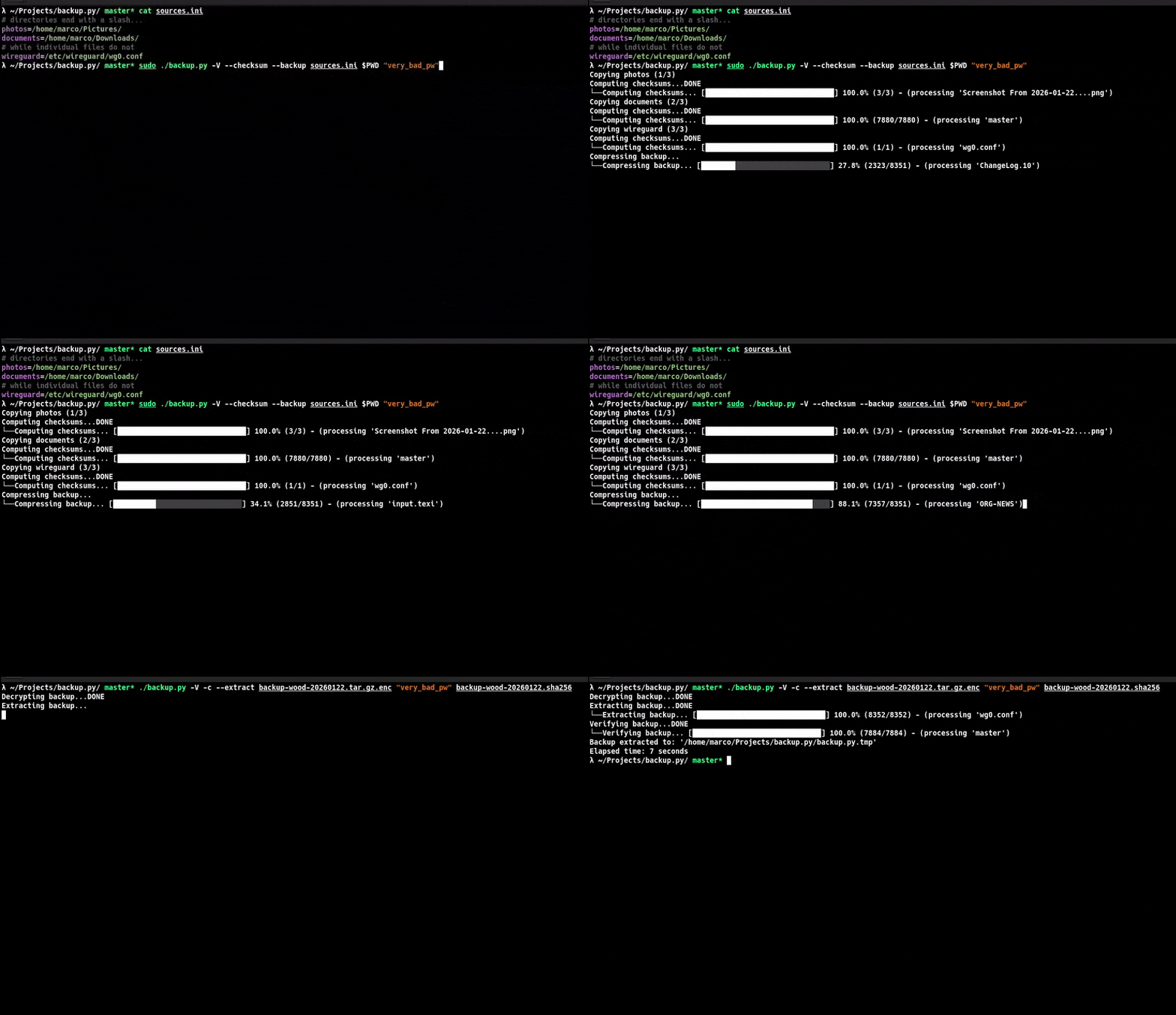
Then, you can start the backup with the following command:
```sh
$ sudo ./backup.py --checksum --backup sources.ini $PWD "very_bad_pw"
Copying photos (1/3)
Copying documents (2/3)
Copying wireguard (3/3)
File name: '/home/marco/Projects/backup.py/backup-wood-20260122.tar.gz.enc'
Checksums file: '/home/marco/Projects/backup.py/backup-wood-20260122.sha256'
File size: 5533818904 bytes (5.15 GiB)
Elapsed time: 2 minutes, 12 seconds
```
The `--checsum` (optional) is used to generate a checksum file containing the hashes of each single of the backup.
To extract an existing backup, you can instead issue the following command:
```sh
$ ./backup.py -c --extract backup-wood-20260122.tar.gz.enc "very_bad_pw" backup-wood-20260122.sha256
Backup extracted to: '/home/marco/Projects/backup.py/backup.py.tmp'
Elapsed time: 1 minute, 3 seconds
```
This will create a new directory named `backup.py.tmp` on your local path. Just like before,
the `-c` option is optional.
## Usage
As stated before, `python.py` is built from scratch in modern Python (3.10+) without using
any external dependency except for `tar` and `gpg`.
The *sources file* follows an INI-like syntax structured using associative records between
labels and absolute paths. In order words:
```ini